

Source : https://camcompsoc.org/cmpeerd-fpac2026-yaounde/
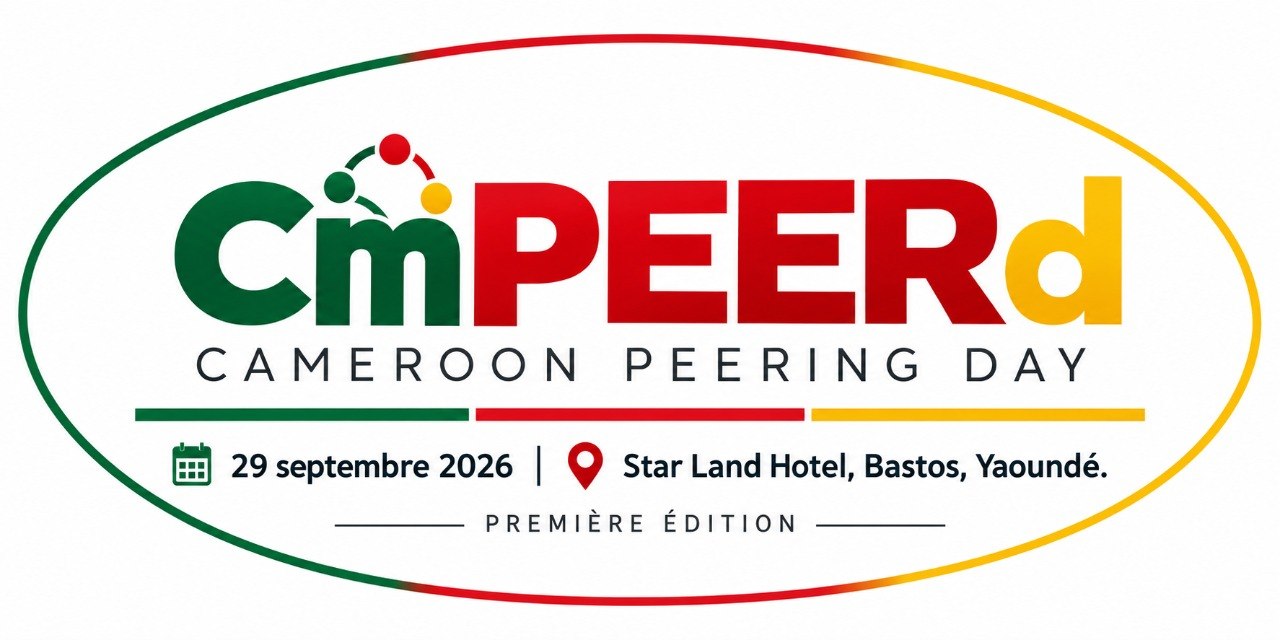
Cameroon Peering Day (cmPEERd) and the Central Africa Peering Forum 2026 (FPAC/CAPF) are co-located at the Star Land Hotel, Bastos, Yaoundé, from Tuesday 29 September to Thursday 1 October 2026. The Cameroon Computer Society (CmrCS) is one of the organisers of Cameroon Peering Day and sits on the forum’s local organising committee.
The forum’s format gives the host country a day of its own. In 2026 that day is Cameroon Peering Day, in its first edition, and the regional forum takes the two days after it.
What peering is, and what weak peering costs
Peering is the arrangement by which networks exchange traffic directly instead of paying a third party to carry it. Where peering is weak, traffic between two networks in the same city can travel to another continent and back. The result is higher latency and higher transit costs, and domestic traffic that depends on links outside the country. An Internet exchange point is the neutral place where that is fixed: networks meet there and hand traffic to each other locally. CAMIX, the Cameroon Internet eXchange point, is Cameroon’s.
Most engineers and students in Cameroon only meet peering as a diagram in a lecture. For three days, the operators, exchange points and content providers who run it will be in the same hotel. The programme also covers regulation and national policy, because many of the limits on interconnection are set there.
Day 1: Cameroon Peering Day, Tuesday 29 September
Cameroon Peering Day is the national day. It is organised by CAMIX, cmNOG, CmrCS, Cameroon Open Internet and Douala-IX, and co-funded by the Internet Society (ISOC) and AFRINIC. It looks at Cameroon’s own networks before the regional discussion starts.
Programme, Yaoundé time (UTC +1):
-
09:00–10:00: opening session
-
10:00–11:00: context, welcome messages and opening, with cmNOG, Cameroon Open Internet, CmrCS and CAMIX, the co-chairs of the FPAC steering committee, the Internet Society and the CAMIX administration committee
-
11:00–11:45: the state of peering in Cameroon
-
11:45–12:00: coffee break
-
12:00–12:30: Peering Personals
-
12:30–13:30: BGP best practices for Internet exchange point (IXP) operations
-
13:00–13:45: round table on the responsibilities of the actors in Cameroon’s peering ecosystem
-
13:45–14:45: lunch
-
14:45–15:30: the state of data centres in Cameroon (CENADI)
-
15:30–16:15: the state of the Cameroonian inter-university network (CNSRIC, the national research and education network)
-
16:15–16:30: coffee break
Do kindly find the full programme here: https://cameroon.peeringday.cm/programme/agenda.html or https://cmpeerd.camix.cm/programme/agenda.html
Days 2 and 3: Central Africa Peering Forum, Wednesday 30 September and Thursday 1 October
The forum is called the Forum sur le Peering en Afrique Centrale (FPAC) in French and the Central Africa Peering Forum (CAPF) in English. Both names refer to the same event. It is organised by the Internet Society and co-hosted by CAMIX as local host.
The forum starts with an opening session on Wednesday 30 September. Sessions 1 to 3 run that day and sessions 4 to 7 on Thursday 1 October:
-
State of the art and ecosystem
-
Global infrastructure
-
CDN and local content development
-
Peering and national digital sovereignty
-
Regional policies and regulation
-
Technology and Internet tools
-
Long-term viability of the peering ecosystem
Topics of interest include peering, infrastructure development, routing security, IRR and RPKI, the economics of peering, the value of Internet exchange points, BGP routing, Internet measurements, and governance and policy. The organisers will publish the detailed forum programme soon.
Before the three days: AFRINIC workshop, Monday 28 September
An AFRINIC Cameroon Members Engagement (ACME) workshop on Internet Number Resource Management (INRM) takes place on Monday 28 September. It is restricted to AFRINIC members, and registration is closed.
Programme, Yaoundé time (UTC +1):
-
09:00–10:00: opening session
-
10:00–11:00: introduction to Internet number resources: about AFRINIC Ltd, number resource policies and the AFRINIC PDP, how to become an AFRINIC member
-
11:00–11:15: coffee break
-
11:15–12:15: introduction to the Whois database and its objects
-
12:15–13:15: querying the Whois database
-
13:15–14:15: lunch
-
14:15–15:45: creating, modifying and deleting Whois database objects; INRM labs
-
15:45–16:00: coffee break
-
16:00–17:30: securing the Whois database; INRM labs
Do kindly find the full programme here: https://cameroon.peeringday.cm/programme/agenda.html or https://cmpeerd.camix.cm/programme/agenda.html
Who should attend
The organisers address the forum to operators, ISPs, IXPs, data centres, regulators, public institutions, technical communities, universities, content providers and international partners. Cameroon Peering Day is the day for anyone working on Cameroon’s own networks.
If you run a network, or decide how one is funded or regulated, the sessions are aimed at you. Students and early-career engineers should start with sessions 1, 2 and 6.
The forum is still accepting abstracts on its Indico site: https://indico.internetsociety.org/event/2/. Working languages are English and French.
What CmrCS is doing
CmrCS is one of the five organisers of Cameroon Peering Day, with CAMIX, cmNOG, Cameroon Open Internet and Douala-IX, and speaks in its opening session. For the forum, it is a member of the local organising committee and a partner, with cmNOG and Cameroon Open Internet.
Funding
AFRINIC and the Internet Society fund Cameroon Peering Day. The Internet Society funds the forum.
What you can do
Each event has its own registration form and website; therefore, to participate in both, you must register for each one separately.
Register for Cameroon Peering Day (September 28–29) using the CAMIX form: https://survey.camix.cm/226454
Register for the FPAC forum (September 30–October 1) via the Internet Society event website: https://www.internetsociety.org/events/central-africa-peering-forum/capf-2026/registration/
The dedicated cmPEERd website can be accessed at the following addresses: https://cameroon.peeringday.cm or https://cmpeerd.camix.cm
The FPAC event page provides details about the forum as they are released: https://www.internetsociety.org/events/central-africa-peering-forum/capf-2026/ or https://fpac.africa
The full agenda for both events is available here: https://cameroon.peeringday.cm/programme/agenda.html or https://cmpeerd.camix.cm/programme/agenda.html
You can still submit a presentation (if applicable) via the Internet Society’s Indico platform at this address: https://indico.internetsociety.org/event/2/.
Registration to become a CmrCS member is open at https://camcompsoc.org/register/
For any questions regarding Cameroon Peering Day or relative to CmrCS's participation in the forum, please email events@camcompsoc.org.
About the Organisations Committed
The Internet Society (ISOC) : a global non-profit organization founded in 1992 dedicated to ensuring that the internet remains open, secure, and accessible for everyone. It carries the following vision: "The Internet is for everyone".
AFRINIC : the Regional Internet Registry (RIR) responsible for managing and distributing critical internet number resources—including IPv4/IPv6 addresses and Autonomous System Numbers (ASNs)—across Africa and the Indian Ocean region.
CAMeroon Internet eXchange point (CAMIX) : The organization responsible for operating the domestic Internet exchange points (IXPs) in Cameroon (cmDOit :: CaMeroon DOmestic InterneT), dedicated to promoting the exchange of local Internet traffic. It is the pioneer IXP operator in Cameroon, having been established as an association on January 24, 2014. CAMIX plays a key role in fostering synergy for the development of shared digital infrastructure, thereby enhancing interconnectivity and the efficiency of digital exchanges within Cameroon.
Cameroon Open Internet (COI) : A community-based organization championing a vision of an Internet—both global and domestic—characterized by digital inclusion, openness, neutrality, collaboration, and universal accessibility. It pursues this vision through initiatives that promote the development of an open, neutral, secure, and reliable Internet for the national population.
Cameroon Computer Society (CmrCS) : a Yaoundé-based non-profit organization founded in 2018 dedicated to building an inclusive digital ecosystem. By bridging the gap between academic researchers and industry professionals, CmrCS drives technological innovation and knowledge sharing to advance Cameroon's educational and economic sectors.
Cameroonian Network Operators’ Group (cmNOG ) : A community organization that initiated events such as the CaMeroon PEERing Day (cmPEERd2026, DPD2024) and launched the Douala-IX Internet exchange point in partnership with the company ST DIGITAL. In addition, cmNOG provides other tools and Public Interest Services (PIS), aiming to bring together all dynamic stakeholders—including researchers, students, engineers, organizations, and network engineering enthusiasts in Cameroon—to foster capacity building; the adoption, deployment, and promotion of open protocols; collaborative maintenance; the implementation and promotion of best practices; and the research, development, operationalization, and maintenance of a high-quality domestic Internet in Cameroon.
Douala-IX : an alternative, open, and neutral Internet Exchange Point (IXP) located in the city of Douala, Cameroon. It is hosted within the ST DIGITAL data center. This IXP is operated collaboratively for Cameroon's Internet community under the coordination of the cmNOG association and ST DIGITAL. Serving as a true digital hub, it enables network operators, Internet Service Providers (ISPs), and content creators to exchange traffic locally and directly. By optimizing data routing, Douala-IX reduces latency, lowers international transit costs, and accelerates Internet connectivity in Cameroon—the leading country in the Central African sub-region.
- Log in to post comments